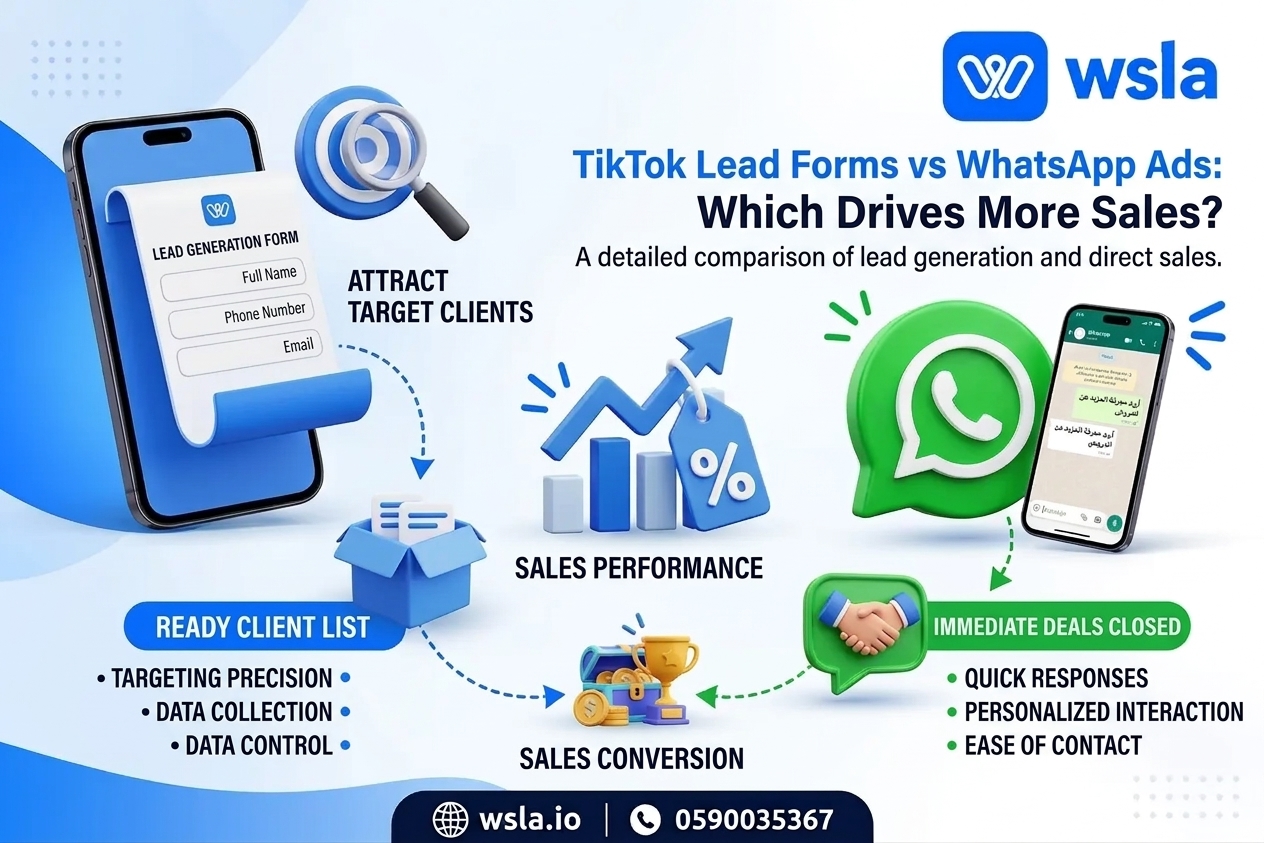
TikTok Lead Forms vs WhatsApp Ads: Which Drives More Sales?
The question comes up in every budget meeting: collect details through an in-app form, or move the customer straight into WhatsApp? The answer is not a matter of taste but of arithmetic. This article puts WhatsApp Lead Generation side by side with the form route and compares them on the metrics that show up in the sales report, not the ad dashboard.
The Core Difference Between the Two Routes
A TikTok Lead Form collects details inside the app: name, number, email, in a tap or two, often auto-filled. The route is fast and built to strip friction to the minimum, which is exactly what makes it look superior to WhatsApp Lead Generation on the surface.
WhatsApp Lead Generation works the opposite way. It does not collect data; it opens a dialogue. The customer types their own question, which starts them much further along the buying journey.
And here is the paradox that governs the whole comparison: the lower-friction route gives you more volume, and the higher-friction route gives you more intent. Anyone judging Lead Generation Forms vs WhatsApp Leads by volume alone will reach the wrong answer every time.
Where the Real Cost Hides
The most common error is comparing Lead Generation Forms vs WhatsApp Leads on the price shown in the ad dashboard. That number excludes your team's time, the calls nobody answered, and the leads that entered the system and never left it.
Calculate it differently: divide spend by completed orders, not by leads. At that division the result flips in most accounts, and the advertised cost per lead reveals itself as a marketing figure rather than an operational one.
Anyone tracking a TikTok Lead Form for a full month will notice a share of the entries went into the database and turned into nothing, while WhatsApp Lead Generation leaves a visible trail of who spoke. That is not a platform problem; it is the nature of the route.
The Decisive Metric: Response Rate
This is where the winner is settled in practice. A lead from a form requires you to make the first move: you call, no answer; you message, no reply. Response rate on this route is naturally low, because the customer never expected to hear from you, and WhatsApp Lead Generation avoids that problem entirely.
In WhatsApp Lead Generation the customer opened the channel, so response rate rises automatically since the dialogue already exists. That difference alone turns the whole calculation upside down.
An illustration, not a benchmark: a hundred form leads with twenty replying makes your true cost five times the advertised figure. Forty chats with thirty replying costs less, even though the unit price is higher. Run the same equation on your own numbers.
Follow-Up Speed Settles It
Follow-up speed is the factor most comparisons ignore. A form lead loses value by the hour and gradually becomes the cold lead your team chases without result, whatever the cost per lead said on day one.
In a chat, follow-up speed is measured in minutes rather than hours, and the first reply can be fully automated. That raises the odds of lead to customer conversion before interest cools, and every hour of delay subtracts from that same conversion.
But the condition is fair to both sides: if your team replies hours later, no route will save you, however fast it looks on paper.
When Is the Form the Better Choice?
The form is not always wrong. A TikTok Lead Form wins in three clear cases:
High-volume campaigns building a database for later marketing rather than immediate selling.
Products that need no discussion, where a number and email are enough, and a TikTok Lead Form adds no burden on the team.
Teams with a disciplined calling operation that can work a cold lead efficiently.
Conversely, WhatsApp Lead Generation wins in consultative sectors: clinics, real estate, and services with variable pricing — where lead quality is higher because the question itself reveals intent.
How to Compare Them in Your Own Account
Do not rely on a general rule. Run Lead Generation Forms vs WhatsApp Leads for two weeks and compare on four columns only: lead volume, share who replied, how many reached a quote, and completed orders. Then calculate lead to customer conversion separately for each route.
Note that lead quality does not surface in week one; it appears after the lead passes through your sales team and receives an outcome. How to build that report is covered in measuring conversation campaign results.
If you choose the chat route, set the campaign to the conversations objective rather than clicks, explained in conversation optimisation on TikTok.
Frequently Asked Questions
Which is genuinely cheaper?
The form is cheaper on advertised cost per lead; WhatsApp Lead Generation is usually cheaper per completed order.
Can I run both routes together?
Yes, and it is the better approach for large accounts, provided you do not judge Lead Generation Forms vs WhatsApp Leads on the same metric.
How to Prevent Lead Drop-Off?
By cutting response time and asking an early qualifying question; every minute of delay risks losing the buyer’s interest.
What is the single most important metric?
Response rate, then lead to customer conversion — both more honest than the advertised figure. Judge WhatsApp Lead Generation on those two.
Is this a fight or a partnership?
Mostly a partnership: forms build the database, chat closes the deal and drives lead to customer conversion.
The Next Step
Judging WhatsApp Lead Generation correctly starts at the orders column, not the leads column. Any comparison that stops at the dashboard figure will lead you to the wrong decision. The full picture of the chat route sits in our guide to tiktok whatsapp ads.
The
WSLA platform is a certified TikTok, Meta and Snapchat partner, providing the reply platform and the reporting that measures a chat through to the order.
Book a
free consultation to review your account.
 WSLA
WSLA